Setări
 Livrare rapidă
 Livrare gratuită
 Incoterms
 Tipuri de plată


 Produs Marketplace


Use a Complete Wi-Fi/Bluetooth Combo Module to Simplify IoT Connectivity
A positive feedback loop between technology and product advances works like this: technological advances increase market demand for products, while this demand drives further advances. This cycle repeats, and costly and rare components and products quickly become inexpensive commodities. Think personal computers, smartphones, and flat-screen TVs.
This is also seen in wireless Internet of Things (IoT) connectivity. Designing and fabricating wireless functions, even for low-volume applications, tends to be the domain of a few RF “magicians.” These include specialists who can design circuits to work at a few hundred megahertz and the companies that manufacture them, often at a relatively high cost. Lately, I have been amazed by the ready availability of complete gigahertz (GHz)-range RF ICs that can help to quickly implement highly sophisticated wireless connectivity at a low cost, in a tiny footprint, and with extraordinary functionality.
Of course, “complete” is often interpreted differently by the vendor and the user. While every active device needs a power source and, most likely, some bypass capacitors, designers may also have to add more active and passive components for successful operation. Complete is, therefore, a function of which components and how many.
Complete modules simplify regulatory compliance
For RF related functions, device completeness is more than just a convenience. A complete RF solution can eliminate two of the biggest challenges of RF design:
• Providing assured compliance with the complex functional requirements of the wireless standards that the circuit supports
• Meeting the many stringent regulations around out-of-band (OOB) emissions, electromagnetic interference (EMI), and radio-frequency interference (RFI) to streamline the product certification process
These design issues become more complicated when the wireless link circuit and function must support multiple versions of a single standard, such as the many Wi-Fi variants (IEEE 802.11xx). It is more challenging when it must support different standards, such as Bluetooth. Even seasoned designers are cautious about developing a full-function RF link to meet a single industry standard; meeting multiple wireless standards in one chip is an even riskier proposition.
Modules deliver the complete solution
A way around all this is to opt for Murata Electronics’ Type 2BZ (LBEE5XV2BZ-883), a dual-band 2.4 GHz and 5 GHz Wi-Fi wireless local area network (WLAN), and Bluetooth transceiver module. This combo solution supports Wi-Fi 802.11a/b/g/n/ac with 2×2 multiple input, multiple output (MIMO), as well as Bluetooth 5.2 basic rate (BR), enhanced data rate (EDR), and low energy (LE). Its physical layer (PHY) data rate is up to 866 megabits per second (Mbps) for Wi-Fi and 3 Mbps for Bluetooth.
Target applications include size and power-sensitive devices such as IoT nodes, handheld wireless systems, home automation, gateways, and others that must meet FCC/CE/IC/TELEC standards. The fully shielded surface-mount module weighs just 0.36 grams (g), has a footprint of only 11.4 × 8.9 millimeters (mm), and a height of 1.4 mm (Figure 1).
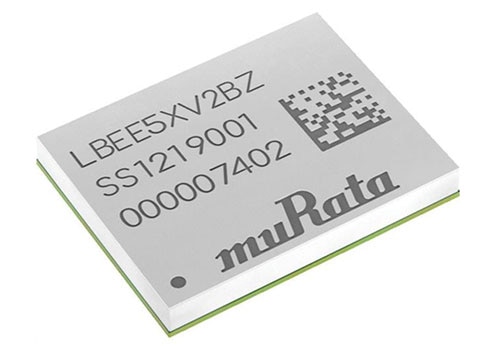 Figure 1: The fully shielded LBEE5XV2BZ-883 is a combo transceiver module for Wi-Fi and Bluetooth that simplifies wireless connectivity implementation. (Image source: Murata Electronics)
The LBEE5XV2BZ is based on Infineon Technologies’ AIROC CYW54590 system on chip (SoC). The CYW54590 includes the transmitter RF power amplifiers (PAs) and receiver low-noise amplifiers (LNAs) (Figure 2). The module addresses critical RF matching, filtering, and antenna interfacing issues. As such, it removes the many challenges associated with creating and certifying an RF circuit and related software.
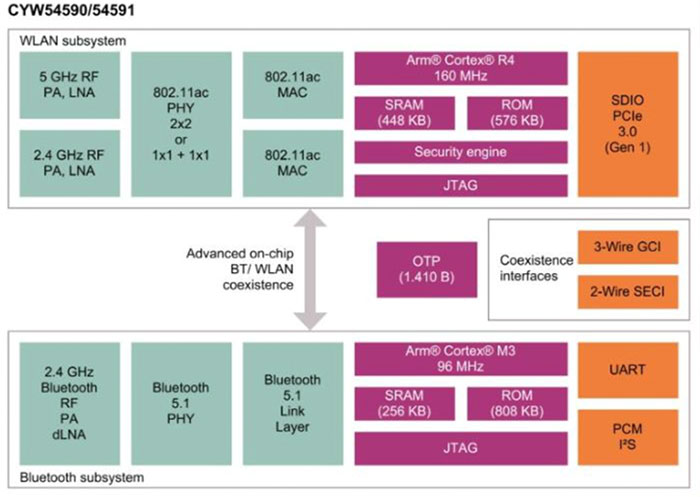 Figure 2 : The Type 2BZ module is based on the CYW54590 Wi-Fi 5 and Bluetooth 5.1 combo SoC with onboard PAs and LNAs. (Image source: Infineon Technologies)
The module supports up to three antennas: one for Bluetooth and two for Wi-Fi. Also, the shared Bluetooth and WLAN receive-signal path eliminates the need for an external power splitter while maintaining excellent sensitivity for both Bluetooth and Wi-Fi.
The CYW54590 incorporates more than just a complete RF function. Its WLAN section supports a standard SDIO interface, and the Bluetooth section supports a high-speed, four-wire Host Controller Interface (HCI), UART, and pulse code modulation (PCM) for audio data (Figure 3).
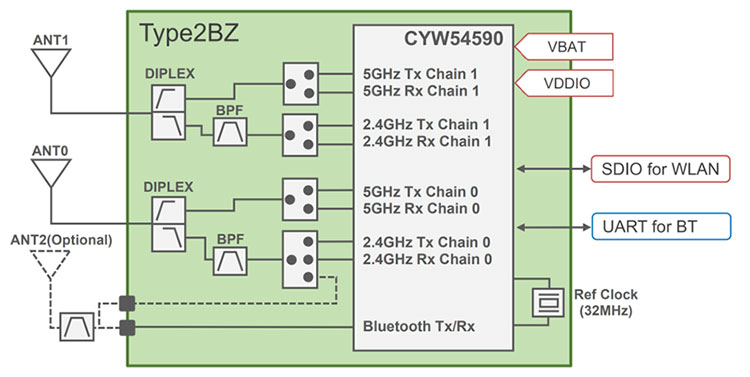 Figure 3 : The Type 2BZ module implements the complete interface between the host processor and up to three antennas for Wi-Fi and Bluetooth functionality. (Image source: Murata Electronics)
Equally critical is the embedded operating firmware. The CYW54590 implements highly sophisticated and collaborative coexistence hardware mechanisms and algorithms to optimize simultaneous Wi-Fi and Bluetooth connectivity.
Note that another module, the Murata LBEE5XV1XA-540, adds Real Simultaneous Dual Band (RSDB) capabilities to support two concurrent Wi-Fi networks, one in the 2.4 GHz band and another at 5 GHz. Based on Infineon’s AIROC CYW54591RKUBGT SoC, the LBEE5XV1XA-540 reduces latency in video/audio streaming or gateway applications.
The completeness of these modules is demonstrated by the minimum number of external components required: a few standard bypass/decoupling capacitors and some pullup resistors for the SDIO data lines. The requirement for just two power supply rails, one a 3.3 volt (nominal) supply for operation, and the other a 1.8 volt or 3.3 volt supply for the I/O lines, also simplifies design-in.
Conclusion
Designers no longer need advanced RF circuit and system skills to embed a sophisticated, multi-band, multi-format Wi-Fi and Bluetooth interface. The Murata Electronics Type 2BZ Wi-Fi/Bluetooth transceiver module, with its CYW54590 combo SoC, RF matching, filtering, and antenna interfaces, provides a drop-in solution that meets regulatory and functional requirements.
About this author

Bill Schweber este un inginer electronist care a scris trei manuale despre sistemele de comunicații electronice, precum și sute de articole tehnice, articole de opinie și articole despre produse. În trecut, a lucrat ca manager de site tehnic pentru mai multe site-uri web cu subiecte specifice pentru EE Times, precum și ca editor executiv și editor Analog la EDN.
La Analog Devices, Inc. (unul dintre cei mai importanți furnizori de circuite integrate analogice și de semnale mixte), Bill a lucrat în domeniul comunicării de marketing (relații publice); drept urmare, a fost de ambele părți ale funcției de PR tehnic, prezentând produsele, poveștile și mesajele companiei către mass-media și, de asemenea, fiind și el un destinatar al acestora.
Înainte de rolul de specialist în comunicări de marketing la Analog, Bill a fost editor asociat al respectabilei reviste tehnice a companiei și a lucrat și în grupurile de marketing al produselor și de inginerie a aplicațiilor. Înainte de aceste roluri, Bill a lucrat la Instron Corp., realizând proiecte practice de circuite analogice și de putere și integrare a sistemelor pentru controlul utilajelor de testare a materialelor.
El are un masterat în inginerie electronică (Universitatea din Massachusetts) și licență în inginerie electronică (Universitatea din Columbia), este inginer profesionist înregistrat și deține o licență de radioamator de clasă avansată. De asemenea, Bill a planificat, scris și prezentat cursuri online pe o varietate de subiecte de inginerie, inclusiv noțiuni de bază despre MOSFET, selecția ADC și acționarea ledurilor.

Have questions or comments? Continue the conversation on TechForum, DigiKey's online community and technical resource.
Visit TechForumMore Blogs from this Author